
Kashmir's Heartbeat: In Trees, Fruits, Fire, and Craftsmanship"
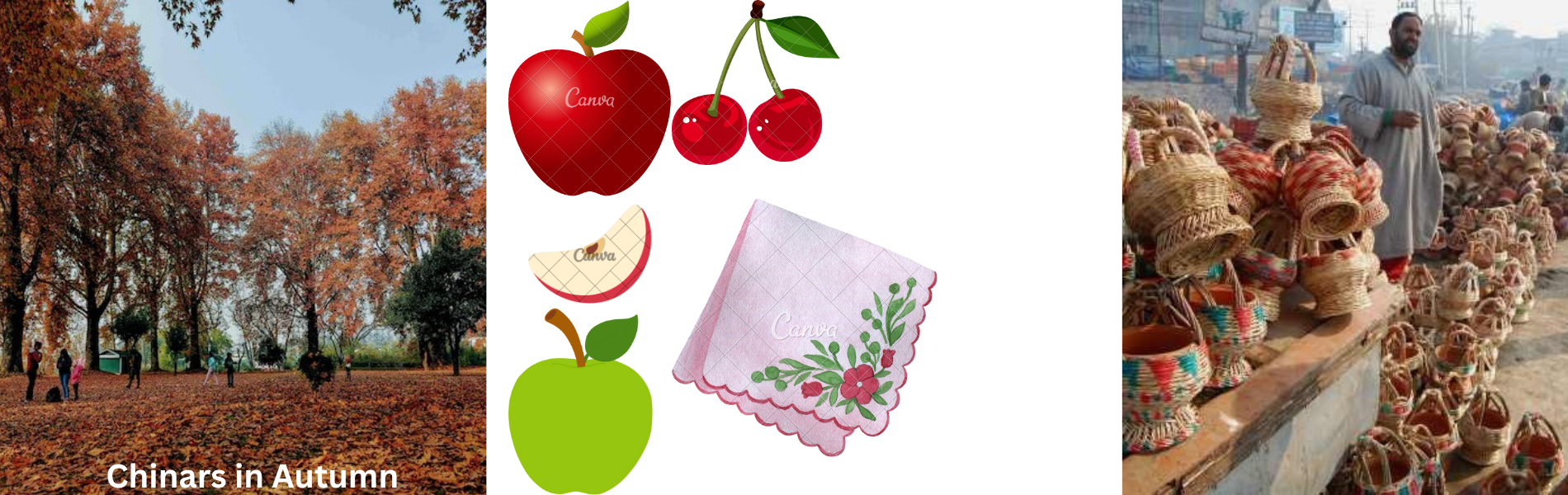
 Chinar Tree – Autumn’s Fire, Kashmir’s Soul
Title: Chinar Tree – Autumn’s Fire, Kashmir’s Soul
Description:
The Chinar tree, locally called Bouin, is not just a tree — it is a living heritage of Kashmir. Towering up to 100 feet and living for centuries, the Chinar symbolizes wisdom, resilience, and beauty. In autumn, its leaves turn vibrant shades of crimson and gold, creating a spectacle across Srinagar's historic gardens and Dal Lake.
Did you know? Mughal emperor Jahangir admired Chinars so much that he ordered them to be planted wherever he traveled.
Spiritual Significance: Chinar trees were considered sacred by Sufis, who meditated under their shade. Their rustling leaves are believed to calm the human soul.
Poetic Line:
"Where a Chinar stands, silence becomes poetry, and leaves whisper the songs of Kashmir."
Chinar Tree – Autumn’s Fire, Kashmir’s Soul
Title: Chinar Tree – Autumn’s Fire, Kashmir’s Soul
Description:
The Chinar tree, locally called Bouin, is not just a tree — it is a living heritage of Kashmir. Towering up to 100 feet and living for centuries, the Chinar symbolizes wisdom, resilience, and beauty. In autumn, its leaves turn vibrant shades of crimson and gold, creating a spectacle across Srinagar's historic gardens and Dal Lake.
Did you know? Mughal emperor Jahangir admired Chinars so much that he ordered them to be planted wherever he traveled.
Spiritual Significance: Chinar trees were considered sacred by Sufis, who meditated under their shade. Their rustling leaves are believed to calm the human soul.
Poetic Line:
"Where a Chinar stands, silence becomes poetry, and leaves whisper the songs of Kashmir."
 Kashmiri Apples – Taste of Heaven, Grown in Silence
Title: Kashmiri Apples – Taste of Heaven, Grown in Silence
Description:
Kashmir is the largest apple-producing region in India, yielding over 2.2 million metric tons every year. Its apples — like Ambri, Red Delicious, and Golden — are renowned for their sweetness, aroma, and crisp texture, all thanks to the clean Himalayan air and fertile soil.
Rare Fact: The Ambri apple is a native variety found only in Kashmir. It is so hardy that it can stay fresh for up to 6 months without refrigeration!
Health Benefits: Rich in antioxidants and fiber, Kashmiri apples improve digestion, strengthen immunity, and promote glowing skin.
Emotional Note:
"Every bite of a Kashmiri apple carries the quiet strength of the mountains and the love of those who nurture it."
Kashmiri Apples – Taste of Heaven, Grown in Silence
Title: Kashmiri Apples – Taste of Heaven, Grown in Silence
Description:
Kashmir is the largest apple-producing region in India, yielding over 2.2 million metric tons every year. Its apples — like Ambri, Red Delicious, and Golden — are renowned for their sweetness, aroma, and crisp texture, all thanks to the clean Himalayan air and fertile soil.
Rare Fact: The Ambri apple is a native variety found only in Kashmir. It is so hardy that it can stay fresh for up to 6 months without refrigeration!
Health Benefits: Rich in antioxidants and fiber, Kashmiri apples improve digestion, strengthen immunity, and promote glowing skin.
Emotional Note:
"Every bite of a Kashmiri apple carries the quiet strength of the mountains and the love of those who nurture it."
 Kashmiri Crafts – Woven by Heart, Carved by History
Title: Kashmiri Crafts – Woven by Heart, Carved by History
Description:
From the softness of handwoven Pashmina shawls to the precision of walnut wood carving, Kashmiri crafts represent centuries of art and devotion. The intricate Papier-mâché designs, Namda rugs, and Khatamband wood ceilings speak of a cultural legacy passed down through generations.
Economic Importance: These crafts support over 300,000 artisans and form a major part of Kashmir's exports.
Rare Fact: The Khatamband ceiling, often seen in shrines and Mughal buildings, is crafted entirely without nails or glue — assembled like a wooden jigsaw puzzle.
Emotional Line:
"These are not just crafts — they are emotions woven into art, born from patience, tradition, and love."
Kashmiri Crafts – Woven by Heart, Carved by History
Title: Kashmiri Crafts – Woven by Heart, Carved by History
Description:
From the softness of handwoven Pashmina shawls to the precision of walnut wood carving, Kashmiri crafts represent centuries of art and devotion. The intricate Papier-mâché designs, Namda rugs, and Khatamband wood ceilings speak of a cultural legacy passed down through generations.
Economic Importance: These crafts support over 300,000 artisans and form a major part of Kashmir's exports.
Rare Fact: The Khatamband ceiling, often seen in shrines and Mughal buildings, is crafted entirely without nails or glue — assembled like a wooden jigsaw puzzle.
Emotional Line:
"These are not just crafts — they are emotions woven into art, born from patience, tradition, and love."
 Kashmiri Kangri – Fire Within the Frost
Title: Kashmiri Kangri – Fire Within the Frost
Description:
The Kangri is a unique earthen firepot wrapped in woven willow, traditionally used by Kashmiris to stay warm during harsh winters. Held close to the body beneath a Pheran (traditional cloak), it brings warmth not just to the skin but to the spirit.
Medicinal Insight: Kangri heat is believed to provide relief from joint pain and cold-related ailments during the sub-zero months of Chillai Kalan.
Rare Tradition: There are more than 12 types of Kangris, including the ceremonial Badshahi Kangri, gifted during weddings and festivals.
Emotional Line:
"The Kangri is not just a pot of embers — it is a mother’s embrace during a snowstorm, a symbol of resilience in silence."
Kashmiri Kangri – Fire Within the Frost
Title: Kashmiri Kangri – Fire Within the Frost
Description:
The Kangri is a unique earthen firepot wrapped in woven willow, traditionally used by Kashmiris to stay warm during harsh winters. Held close to the body beneath a Pheran (traditional cloak), it brings warmth not just to the skin but to the spirit.
Medicinal Insight: Kangri heat is believed to provide relief from joint pain and cold-related ailments during the sub-zero months of Chillai Kalan.
Rare Tradition: There are more than 12 types of Kangris, including the ceremonial Badshahi Kangri, gifted during weddings and festivals.
Emotional Line:
"The Kangri is not just a pot of embers — it is a mother’s embrace during a snowstorm, a symbol of resilience in silence."

 Snow-Capped Mountains & Pine Forests of Kashmir – The Silent Saints of the Valley
“If there is a paradise on earth, it is this, it is this, it is this.”
– Amir Khusro
 A Canvas Painted by the Creator
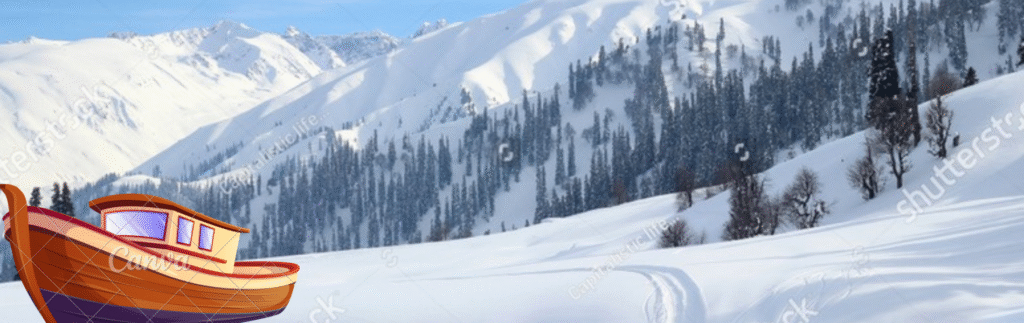
Kashmir’s snow-covered mountains and vast pine forests are more than landscapes — they are living poetry written in ice, rock, and wood. These towering giants are guardians of heritage, keepers of silence, and witnesses of time. Draped in snow during the winters and kissed by clouds in summers, these peaks whisper ancient secrets to every traveler.
 The Snow-Capped Mountains – Crown of the Valley
The Himalayan and Pir Panjal mountain ranges wrap Kashmir like a royal robe. Some peaks like Harmukh (16,890 ft), Mount Kolahoi (17,799 ft) and Amarnath (17,321 ft) remain snow-clad year-round, creating an enchanting view that calms even the most restless soul.
 These mountains feed the valley’s rivers and lakes, acting as climate regulators.
 Sages, saints, and mystics sought refuge here, finding inner peace in outer silence.
- Tourism Boost: Thousands flock every year to Gulmarg, Sonmarg, and Pahalgam to ski, trek, and witness snow’s divine beauty.
Pine Trees – Kashmir’s Emerald Silence
The Deodar (Cedrus deodara), Kail (Pinus wallichiana), and Fir (Abies pindrow) forests of Kashmir stand tall like spiritual sentinels, lining valleys, hills, and high-altitude passes.
 These evergreen conifers thrive between 6,000 to 12,000 feet, giving Kashmir its iconic alpine character.
- Their scent purifies the air, their shade cools the earth, and their presence soothes the soul.
- The Deodar, meaning Tree of the Gods, was once considered sacred by sages, and many temples were built using its wood.
 Loram Sahib of London on Kashmir’s Climate (Historical Mention)
In the late 1800s, Dr. John Gordon Loram, a British scholar, poet, and traveler, described Kashmir’s climate as:
“…a land where spring walks gently, summer rests in soft sunlight, autumn glows like gold, and winter reigns in white silence… Kashmir’s air, though light and alpine, carries warmth of peace — like Switzerland clothed in mysticism.“
His writings in London journals compared Kashmir’s climate to the Alps, but with a soul that belongs only to the East.
 Amazing Facts & Figures
- Elevation: Kashmir valley lies at 5,200 ft, surrounded by peaks ranging from 13,000 to 18,000 ft.
- Forest Area: Over 20% of Kashmir’s land is under forest cover, majority being coniferous alpine forests.
- Snowfall: Gulmarg receives 15-20 ft of snow every winter – one of the highest in South Asia.
 Tourism Impact: Over 2.2 million tourists visited Kashmir in 2023, mainly for its snowy landscape and pine-filled treks.
 Historic Travelers: Famous historical visitors include Xuanzang (Chinese Buddhist monk), Sir Aurel Stein, and Francis Younghusband — all mesmerized by Kashmir’s mountain magic.
 Spiritual and Emotional Touch
These mountains and forests are not just part of nature — they are part of the soul of Kashmir. The pine trees whisper prayers, the snow sings lullabies, and the winds tell stories of kings, Sufis, poets, and shepherds.
“Crowned by Snow, Rooted in Silence”
“Pine and Peak – The Soulful Silence of Kashmir”
“Nature’s Architecture: Mountains That Speak, Trees That Heal”
 Call to Action
“Let your heart listen to the whisper of these forests… and your soul will hear the voice of Kashmir.”
 Lakes of Kashmir – The Eyes of the Valley
“If the snow-capped mountains are the crown of Kashmir, its lakes are surely the eyes that reflect its soul.”
 Introduction – A Valley of Living Water
Kashmir, the crown jewel of the Himalayas, is blessed with more than 1,000 freshwater lakes, nestled between its lush meadows and snow-clad peaks. These lakes are not just water bodies — they are living reflections of Kashmir’s soul, shaping its history, climate, culture, economy, and poetry.
 Dal Lake – The Jewel in Kashmir’s Crown
Title: Dal Lake – A Floating Poem in the Heart of Srinagar
Description:
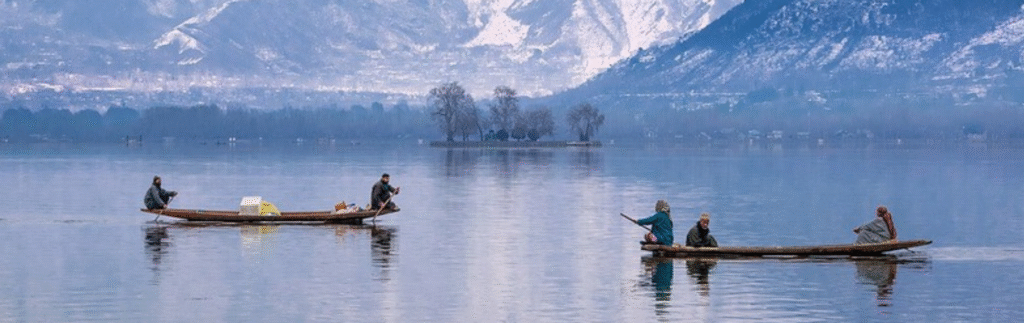
At the heart of Srinagar lies Dal Lake, spanning around 22 square kilometers, changing colors with the seasons, and moods with the hours. Known as “Srinagar’s Jewel”, it reflects the snowy Zabarwan mountains, the sky’s mood swings, and the soul of the valley.
-
 Famous For:
Shikaras (wooden boats), floating gardens (Rad), houseboats (doonga), lotus blooms, and the Mughal gardens on its banks. -
 Cultural Essence:
Dal Lake is not just a tourist spot — it’s a living neighborhood. Locals grow vegetables on floating gardens, sell flowers from boats, and even go to school via water routes! -
Historic Mentions:
Mughal emperor Jahangir built Shalimar and Nishat gardens on its shore. In his words:“If there is a paradise on earth, it is here, it is here, it is here.“
-
Floating Gardens (Rad):
These are artificial islands made of aquatic plants and mud — a 200-year-old eco-agricultural miracle still in use. -
 Tourism & Economy:
Dal Lake draws millions of tourists every year, contributing significantly to local income through houseboat stays, shikara rides, handicraft markets, and water-based vegetable farming.
 Other Breathtaking Lakes of Kashmir
 Wular Lake – One of Asia’s Largest Freshwater Lakes
-
Location: Bandipora district
-
Area: Varies from 30 to 260 sq. km (depending on season)
-
Importance: Acts as a natural flood basin for the Jhelum River
-
Ecological Note: Supports thousands of migratory birds, fish species, and wetland plants
 Manasbal Lake – The Lake of Lotus
-
Often called “the Supreme Gem of all lakes in Kashmir”
-
Famous for: Abundant lotus blooms, bird watching, and ancient ruins of Jarokha Bagh
-
Depth: Deepest lake in Kashmir (~13 meters)
Gangbal Lake – Glacier’s Mirror
-
Located at the foothills of Mount Harmukh
-
Considered sacred by Kashmiri Pandits
-
Accessible via trekking from Sonmarg or Naranag
-
A pristine alpine lake surrounded by snow and stillness
 Nigeen Lake – The Silent Sister of Dal
-
Connected to Dal Lake by a narrow strait
-
Known for its peaceful atmosphere, luxury houseboats, and stunning reflections of Poplar trees
Rare and Amazing Facts
| Feature | Fact |
|---|---|
 Dal Lake Length Dal Lake Length |
~7.4 km long & ~3.5 km wide |
| Floating Homes |
900+ registered houseboats on Dal |
 Floating Veggies Floating Veggies |
Over 600 families grow vegetables on Rad |
 Bird Biodiversity Bird Biodiversity |
121+ bird species spotted around Wular |
 Historical Legacy Historical Legacy |
Referenced in 14th-century Persian and Kashmiri chronicles |
 Tourism Magnet Tourism Magnet |
Dal Lake alone contributes to 35% of tourist income in Srinagar |
 Emotional and Poetic Touch
“To see the Dal at sunrise is to watch the heavens open.
To glide on its waters is to float through a dream.
To live beside it, is to live inside poetry.”
In the mirror of these lakes, the sky finds its reflection, and Kashmir finds its truth. The Dal isn’t just water — it’s heritage in motion, culture afloat, and nature alive.

“Whispers of Water: Where Kashmir’s Soul Flows in Lakes”
or